
Crypto is full of opportunity—and opportunists. As adoption grows, so does the sophistication of scams. Fraudsters prey on newcomers who may not know what legitimate crypto services look like. Pinterest is full of alluring pins promising astronomical returns and secret coin picks; many of these links lead straight to scammers.
This article exposes the most common scams we see in 2026, explains how they work and offers clear steps to protect yourself. Use it as a primer, not a replacement for personal due diligence.
Why crypto scams are rising
Scammers evolve quickly.
According to 2026 reports, crypto fraud is increasing and new tactics are emerging. Attackers use phishing emails, fake websites and social engineering to harvest login credentials and private keys. Sophisticated schemes such as pig-butchering build trust over weeks or months before striking.
At the same time, social media hype drives interest in new tokens, creating fertile ground for rug pulls and pump-and-dump schemes. Staying safe requires understanding these tactics and remaining sceptical of anything that sounds too good to be true.
The most common crypto scams in 2026
Pig-butchering scams
In a pig-butchering scam, the perpetrator wins the victim’s trust through friendly conversation, often over social media or dating apps, then convinces them to buy crypto on a fake platform.
The scammer may appear well off and knowledgeable and will share stories to build rapport. Eventually they offer to help the victim invest; the funds disappear once deposited.
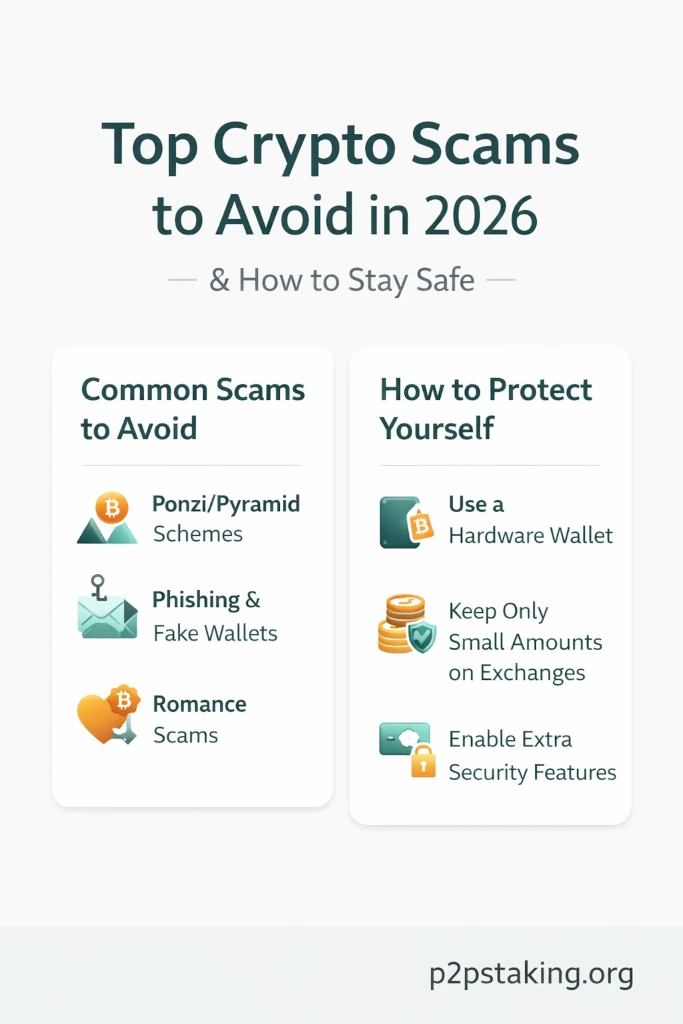
How to avoid: Be wary of strangers who talk about investment opportunities. Don’t mix romance and money. If someone you’ve never met urges you to buy crypto or move funds to a site you’ve never heard of, it’s likely a scam.
Rug pulls
A rug pull1 occurs when developers hype a new token or NFT project, attract investors and then abandon the project, taking the funds with them.
The term comes from “pulling the rug out from under” investors. These scams thrive on FOMO and social media hype.
How to avoid: Investigate project teams, code audits and tokenomics. Be sceptical of anonymous developers and promises of guaranteed returns. Don’t invest money you can’t afford to lose in meme coins or newly launched tokens.
Romance scams
Romance scammers cultivate long-term relationships with victims before suggesting a “great” crypto investment. They often position the investment as a way to build a life together. Once the victim sends funds, the scammer disappears.
How to avoid: Keep financial decisions separate from your personal life. If someone you met online asks you to invest in crypto, stop and seek independent advice.
Fake exchanges and wallets
Scammers create slick-looking websites2 or mobile apps that mimic legitimate exchanges and wallets. They may even use deepfake celebrity endorsements. Victims deposit funds or seed phrases and then lose everything.
How to avoid: Always verify domain names and download wallets from official sources. Never enter your seed phrase into a website or unknown form. Check reviews and regulatory registrations before transferring funds.
Phishing attacks
Phishing emails, texts and social media messages often claim there’s a problem with your account and urge you to click a link.
The link leads to a fake login page where your credentials or seed phrase are stolen.
How to avoid: Never click unsolicited links. Access your exchange or wallet by typing the URL manually or using a bookmark. Enable two-factor authentication and withdraw address whitelisting.
Giveaway and airdrop scams
Fraudsters impersonate well-known companies or influencers and promote “giveaways” or “airdrops” of free tokens. They ask you to send a small amount of crypto to “verify” your wallet; you receive nothing in return.
How to avoid: Genuine projects never ask you to send funds to receive an airdrop. Be suspicious of social media giveaways, and verify promotions via official websites.
Pump and dump schemes
In a pump-and-dump, scammers promote a low-value token to inflate its price, then sell their holdings at the top. When they dump, the price crashes and unsuspecting buyers are left with worthless tokens.
How to avoid: Ignore anonymous tips and celebrity endorsements for obscure tokens. If a coin’s price is skyrocketing purely due to social media hype, it’s probably a pump-and-dump.
Ponzi and pyramid schemes
Ponzi schemes promise high returns with little risk. In crypto, they often involve tokens that appear to pay out but actually use new investor funds to pay earlier participants. Eventually the flow of new investors dries up and the scheme collapses.
How to avoid: Any investment guaranteeing high returns with no risk is likely fraudulent. Research whether a project has sustainable revenue or if it relies solely on recruitment.
How to protect yourself
Use the following practices to reduce the risk of falling for scams:
- Never share your seed phrase or private keys. Your seed phrase is the master key to your funds; no legitimate service will ask for it. Keep it offline, on paper or metal, and store copies in separate secure locations.
- Use hardware wallets for long-term storage. Hardware wallets keep your keys offline and sign transactions internally, making remote hacks extremely difficult. For multi-asset users, Ledger devices like the Nano S Plus and Nano X support thousands of coins; Trezor’s Safe 3 and Safe 5 offer open-source firmware with secure elements.
- Keep only small amounts on exchanges. Exchanges are convenient for trading and on-ramps but shouldn’t be used as vaults. Withdraw to self-custody after each transaction.
- Enable account security features. Use strong, unique passwords, two-factor authentication and withdrawal address whitelisting on every exchange. Avoid re-using passwords across services.
- Verify domains and updates. Bookmark the official websites of your exchanges and wallets; never trust links sent via email or social media. When updating wallet firmware, only download from the manufacturer’s site.
- Be sceptical of unsolicited investment offers. If someone you don’t know pitches a crypto investment, it’s almost always a scam. Legitimate opportunities don’t require urgent decisions or secret tips.
- Do your research. Before buying a new token, read the whitepaper, check the team’s credibility, look for code audits and understand the tokenomics. Independent reviews and community discussions can reveal red flags.
- Test with small amounts. When depositing to a new platform or sending funds to a new address, send a small test transaction first. This mitigates losses if you’ve made a mistake or the platform is fraudulent.
What to do if you suspect a scam
- Stop sending money immediately. Don’t try to recover losses by sending more funds.
- Cut off communication with the scammer. Block them on messaging apps and social media.
- Document evidence. Take screenshots of messages, transaction IDs and website URLs. This information will help authorities investigate.
- Report the scam. Contact your local financial regulator, consumer protection agency or police. In many countries you can file complaints through online portals.
- Notify your exchange or wallet provider. If you think your exchange account was compromised, contact support and freeze your account.
- Warn others. Sharing your experience can prevent others from falling for the same scam. Report fake accounts on social media platforms.
Stay informed and stay safe
Crypto security is a journey, not a destination. New scams will emerge, but the basic principles of caution remain the same: control your keys, verify everything, and be sceptical of anyone promising easy money. Explore our self-custody guides and reviews to deepen your knowledge.
If you’re just starting out, open an account with a trusted exchange like CEX.IO or Binance, then invest in a hardware wallet to protect your holdings.
Armed with the right information and tools, you can enjoy the opportunities of crypto while minimizing your exposure to its darker corners.

Java‑certified engineer and P2PStaking CEO, I secure validators across Solana, Polkadot, Kusama, Mina, and Near. My articles reflect hands‑on wallet ops and real recovery drills so you can set up self‑custody safely, step by step.
Ready to Take Control of Your Crypto?
Go deeper into self‑custody, software wallets, hardware wallets, and practical guides.
Footnotes
1: AnubisDAO is know example of a rug pull which happened in 2021
2: Known fake exchanges, but new ones arise every day